Showing posts with label Enron. Show all posts

Monday, November 1, 2010

Enron's Skilling to Seek Release

The Wall Street Journal
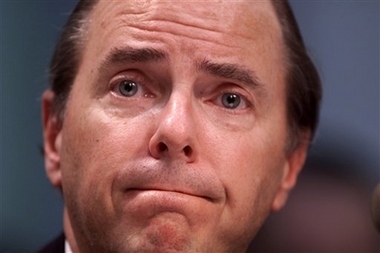


What will likely be the last, best chance for former Enron Corp. President Jeffrey Skilling to get out of prison soon is scheduled to be heard in a Houston federal court on Monday.

A three-judge panel of the Fifth U.S. Circuit Court of Appeals will hear arguments about how many, if any, of the 19 felony counts on which Mr. Skilling was convicted in 2006 should be overturned as a result of the landmark Supreme Court decision in his case.

The Supreme Court in June found that the Justice Department had been misapplying a crime theory, known as "honest services" fraud, in Mr. Skilling's case and others. The court held that honest-services fraud could only be used when someone failed to live up to his fiduciary duties as a result of taking a bribe or kickback, which wasn't alleged in the Skilling case.

The ruling raised immediate hopes among his defenders that Mr. Skilling, who is incarcerated at a federal facility in Colorado and has served nearly four years of a 24-year sentence, might soon be released.

The Supreme Court's Skilling decision sparked a wave of defense requests to throw out cases that used the honest-services fraud theory, and some have been dropped. At the same time, observers believe that the fate of Mr. Skilling, an emblematic figure of this century's first big wave of corporate scandals, remains in doubt.

The Supreme Court decision "could turn out to be a major victory for the defense bar but a pyrrhic one for Mr. Skilling," says Jacob Frenkel, a former federal prosecutor and enforcement attorney for the Securities and Exchange Commission who is now in private practice in Potomac, Md.

Mr. Frenkel believes the appellate panel could uphold much and possibly all of the case against Mr. Skilling on the theory that prosecutors had proven their case on grounds other than honest-services fraud.

Rather than ruling on the validity of Mr. Skilling's conviction—which included conspiracy, securities fraud and insider trading counts—the Supreme Court sent the matter back to the same Fifth Circuit panel that had previously upheld his conviction with the instruction to determine whether its honest-services decision required the dismissal of any or all of the 19 counts.

One potentially bad sign for Mr. Skilling came when a member of his three-judge panel recently turned down his request for bail following the Supreme Court decision. Legal observers say that decision suggests the panel doesn't yet believe the Supreme Court decision will knock out enough of the case to result in Mr. Skilling's immediate release.

Mr. Skilling's lawyers argue that all 19 counts were tainted by the use of honest-services fraud theory and thus should be overturned and their client given a new trial.

Mr. Skilling's "convictions are presumptively invalid" and there isn't any way for the government to prove that jurors didn't rely on the honest-services fraud theory to reach their verdicts, one defense court filing says. The filing also notes that one Fifth Circuit judge in a 2006 ruling wrote that use of the honest-services fraud theory created "serious frailties" in 14 of the 19 counts. However, that jurist isn't a member of the current three-judge panel.

In a recent interview, Daniel Petrocelli, Mr. Skilling's lead defense attorney, said "the law requiring reversal is extremely favorable to our position given the record of our case."

For Mr. Skilling, he added, the upcoming hearing and subsequent decision are "crucial to the rest of his life."

A government court filing counters that none of the counts needs to be overturned. Prosecutors at the 2006 trial sufficiently proved their case under the still-valid criminal theory of securities fraud and therefore any use of honest-services fraud was a "harmless" error, the filing says.

The 2006 trial, the filing says, "overwhelmingly demonstrated that Skilling participated in a conspiracy to commit securities fraud by manipulating Enron's earnings…and deceiving the investing public."

A Justice Department spokesman declined to comment.

The appellate panel could take several weeks or months to hand down a decision.

Thursday, September 16, 2010

U.S. Won't Seek Retrial in Enron Case

The Wall Street Journal

 
In the latest twist in the government's multi-year prosecution of the Enron Corp. scandal, the Justice Department moved Wednesday to drop charges against a former Merrill Lynch & Co. official days before a scheduled retrial involving the only criminal case brought against Wall Street figures in the alleged misdeeds at the onetime energy giant Enron Corp. .

The Justice Department asked a federal judge in Houston to drop fraud and conspiracy charges against James A. Brown, a former Merrill official who along with three former brokerage-firm colleagues was convicted in 2004 in connection with a 1999 deal known as the "Nigerian barge transaction."

A Justice Department spokeswoman declined to comment.

At the 2004 trial, prosecutors alleged that Enron's sale of an interest in three power-producing barges, located off the coast of Nigeria, to Merrill was a sham that allowed the energy company to illegally book a profit. Prosecutors said the deal wasn't legitimate because Enron had promised to take Merrill out of the deal within six months at a predetermined profit. This guarantee meant that Merrill was never at risk, so Enron couldn't legally treat the deal as a sale. The four Merrill defendants, who went to prison in 2005, maintained they did nothing illegal.

The barge case was widely viewed as an effort by the government to send a message to the financial community about acceptable and unacceptable conduct in helping major corporations structure their finances. It was also viewed as an early test case for the Justice Department's Enron Task Force, which eventually secured more than a dozen guilty pleas from former Enron officials. Its work culminated in the 2006 fraud and conspiracy convictions of former Enron chairman Kenneth Lay and former president Jeffrey Skilling. Mr. Lay died shortly after of heart-related problems and Mr. Skilling is still appealing his conviction and 24-year prison sentence.

But some of the government's trial-court success on Enron has unraveled in the appellate courts. In 2006, for example, the Fifth Circuit U.S. Court of Appeals overturned the fraud and conspiracy convictions of Mr. Brown and the other defendants from Merrill, which was purchased in January 2009 by Bank of America Corp. The appellate court upheld Mr. Brown's conviction for perjury and obstruction of justice in connection with the Enron investigation. As a result of the appellate ruling, Mr. Brown and the three other Merrill defendants were released from prison at various points in 2006.

In 2007, the government moved to put Mr. Brown back in prison, arguing that his roughly twelve months of incarceration wasn't long enough to satisfy his perjury and obstruction convictions. A year earlier, the government hadn't opposed Mr. Brown's release. U.S. District Judge Ewing Werlein Jr., who has presided over the barge case, denied the government's request.

The government has resolved its disputes with the other Merrill defendants, including in one case dismissing the remaining charges. However, it pressed on against Mr. Brown.

In recent months, his attorneys and prosecutors have made numerous court filings in anticipation of the retrial, which Judge Werlein had scheduled for Monday. Mr. Brown's attorneys contended in court filings that all charges should be thrown out for prosecutorial misconduct. The filings argued that the government withheld key exculpatory evidence from the defense before the 2004 trial. Such failure violates the law, the defense argued. However, Judge Werlein ruled in favor of the government, which argued that it had turned over all necessary material before the 2004 trial.

On Friday, the Justice Department unexpectedly asked Judge Werlein to postpone the trial. A government filing argued that Mr. Brown's continued efforts to appeal his perjury and obstruction convictions might eventually force the government to add those counts back into the case. Any trial should be postponed until all possible charges could be handled at once, the filing said.

Mr. Brown's attorneys vehemently opposed a continuance. In a filing, they said they had recently contacted key government witnesses from the 2004 trial, who told them they hadn't heard from the government—in one case for years. Such lack of preparation "suggests that the government has been using the court to run an outrageous 'bluff'….for the improper purpose of continuing to harass and persecute Brown and threaten his liberty," the filing said.